
Generative AI has arrived in everyday office work – often faster than policies and training can keep up. Five simple rules help your company reap the benefits without putting data or trust at risk.
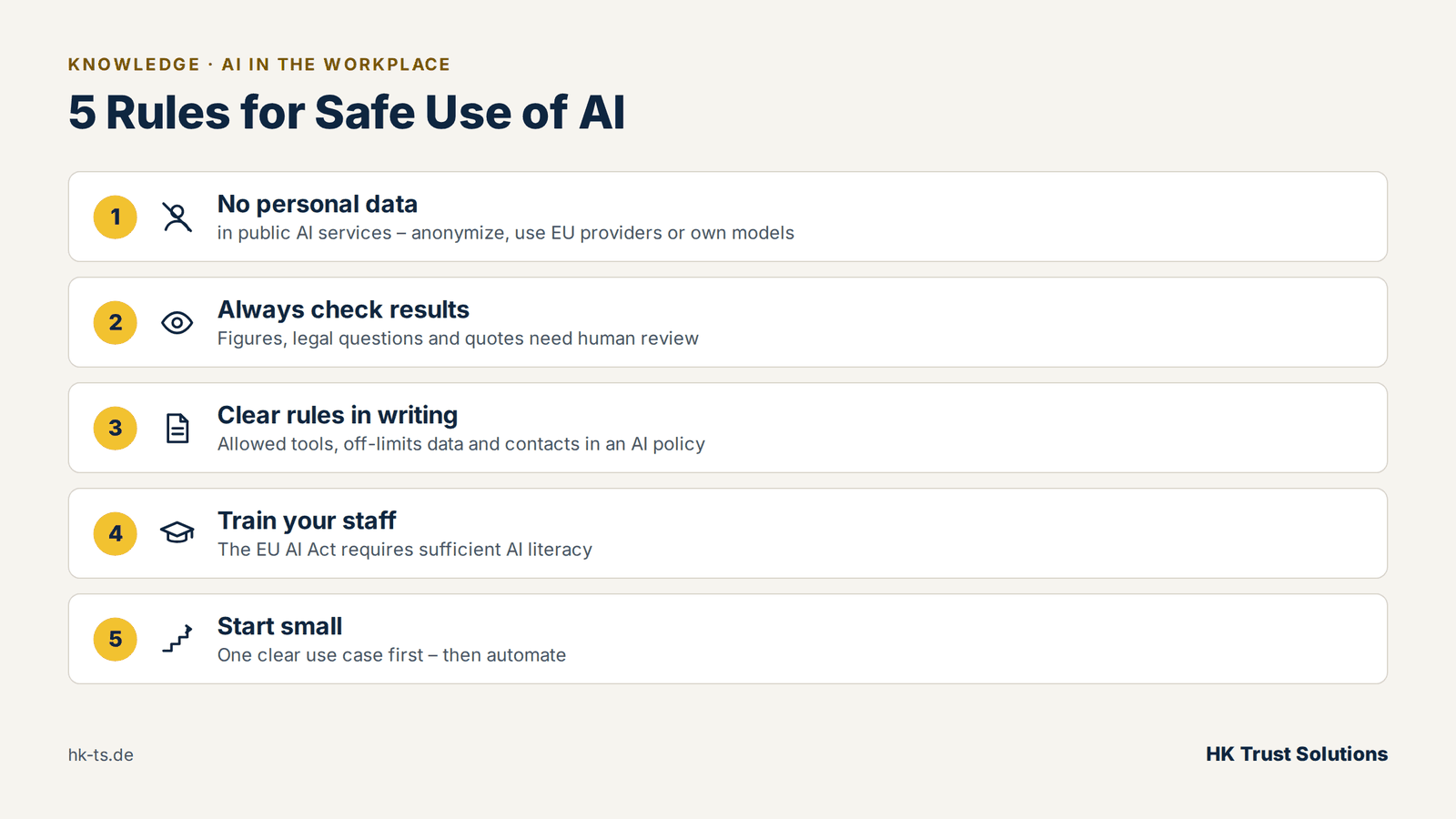
1. No personal data in public AI services
Names, customer numbers, health or HR data do not belong in freely available chatbots. Use business editions with a data processing agreement, or anonymize content first.
Important: a business edition alone is not enough. With US providers, the US CLOUD Act applies: US authorities can compel the provider to hand over data – even if it is stored in a data center in the EU. In addition, Section 702 of FISA allows access to data of non-US persons for foreign intelligence purposes. Such orders often come with a gag order, so the affected company usually never finds out. Neither a data processing agreement nor the EU-US Data Privacy Framework changes this.
For confidential customer and business data, European providers without a US parent company or self-hosted AI models are therefore the safer choice. Where that is not possible, data should be consistently anonymized before it is entered.
2. Always check the results
AI sounds convincing – even when it is wrong. Figures, legal questions and quotes need to be reviewed by a person before they are used. Responsibility stays with the company.
3. Put clear rules in writing
A short AI policy defines which tools are allowed, which data is off-limits and who to contact. That gives employees and management certainty.
4. Train your employees
The EU AI Act requires staff who use AI to have sufficient AI literacy. Hands-on training shows how to get good results and how to recognize risks.
5. Start small, then automate
Begin with a clearly defined use case – such as summarizing e-mails or extracting data from invoices. Once the benefit is measurable, automating entire workflows pays off.
Want to introduce AI safely in your team? In our AI training we work through exactly these points together with your employees.